
When tragedy creates noise
There is a lot of noise surrounding the tragic Prime Air crash in Miami, and understandably so.
People have lost their lives. Others have been seriously injured. Families are grieving and facing circumstances none of them expected when that day began. An investigation is underway, footage is being examined, aviation experts are trying to understand what occurred and, inevitably, speculation has begun about what—or who—was responsible.
In moments like these, how we open the conversation matters.
We cannot allow our desire to understand what happened to diminish the very real human loss and suffering involved. Behind every headline, every piece of footage and every technical discussion are people whose lives have been profoundly changed.
But nor should our understandable desire for answers become a witch hunt.
Somewhere between silence and speculation, between minimising what happened and rushing to assign blame, we need to create enough space to examine what is known, acknowledge what isn’t, ask difficult and sometimes confronting questions, and remain open to the possibility that the picture we form today may change as more information becomes available.
That is why I found Captain Steeeve’s recent analysis of the crash so interesting, and why I wanted to share some reflections on his approach.
Helping us see what we might otherwise miss
What caught my attention wasn’t simply Captain Steeeve’s aviation expertise, although more than 23 years flying the Boeing 767-300 obviously gives him a depth of knowledge most of us watching the footage simply don’t possess.
It was how he chose to use that expertise.
From the beginning, he was clear that the probable cause had not been determined, that the NTSB investigation was underway, and that there could be circumstances that were not yet known. He wasn’t presenting a completed investigation or claiming to have all the answers; he was examining the information currently available and inviting us to look more closely at what could actually be observed.
That distinction is important.
He slowed the footage down, sometimes almost frame by frame, and pointed to details that someone like me, who is not a pilot, would never have known to look for. He explained what we were seeing, why particular observations mattered, how different parts of the aircraft and its systems interact, and how one developing condition could affect what happened next.
Suddenly, I wasn’t simply watching footage of an aircraft travelling down a runway.
I was beginning to understand some of the relationships between what I could see.
That is a very different form of communication from simply giving people a conclusion and expecting them to accept it because an expert said so. Captain Steeeve made his reasoning visible, allowing the viewer to follow the evidence, understand why particular observations mattered and, importantly, recognise where the limits of the available information remained.
At one point, while examining something he couldn’t explain from the footage, he simply acknowledged that he didn’t know what was happening.
There is something deceptively powerful about an expert being willing to say, “I don’t know.”
Expertise should help us see further. It shouldn’t require us to pretend we can see around every corner.
I have included Captain Steeeve’s analysis below because I think it is worth watching—not because we should treat his observations as the final word on what happened, but because there is something valuable in watching how he works through what can currently be observed, what his experience tells him, what remains unknown, and what further evidence could change.
We don't need certainty before we can begin learning
As Captain Steeeve worked through the footage, he distinguished between information that had been reported, what he could observe, what his experience suggested those observations might mean, and what remained unknown.
That allowed something important to happen: learning could begin without pretending uncertainty had disappeared.
This matters because uncertainty is so often treated as an inconvenience that needs to be eliminated before we can make a decision or form a view. Yet in organisations, communities and our own lives, we rarely have the luxury of complete information. We make decisions while circumstances are still developing, while evidence is incomplete and while multiple explanations remain possible.
The challenge, therefore, isn’t always to remove uncertainty. It is to become better at navigating it.
That means asking not only What do we know?, but How do we know it? What can we genuinely observe? What are we interpreting? What are we assuming? What remains unknown? What alternative explanations should remain on the table? And what additional information could materially change our current understanding?
Captain Steeeve did not avoid making professional observations simply because the investigation was incomplete. He raised uncomfortable questions and, at times, expressed strong views about what the footage appeared to show. But he also repeatedly left the door open to additional information, including the possibility of aircraft issues, environmental conditions or other factors that could alter the picture as the investigation progressed.
That combination matters: the courage to say what we can see, coupled with enough humility to acknowledge what we cannot yet know.
Risk rarely travels in one direction
There was another aspect of Captain Steeeve’s analysis that particularly resonated with me because, without calling it this, at a high level he was moving through something I have long referred to as Risk To and Risk By.
We have a tendency when something goes wrong to look for the source of the risk. What failed? Who made the decision? Which control didn’t operate? What created the problem?
Those questions matter, but they only give us part of the picture.
A Risk To / Risk By lens asks us to look in both directions.
What risks or conditions was this person, system, decision, control or environment exposed to?
And then:
What risk did it subsequently create, influence or amplify for something else?
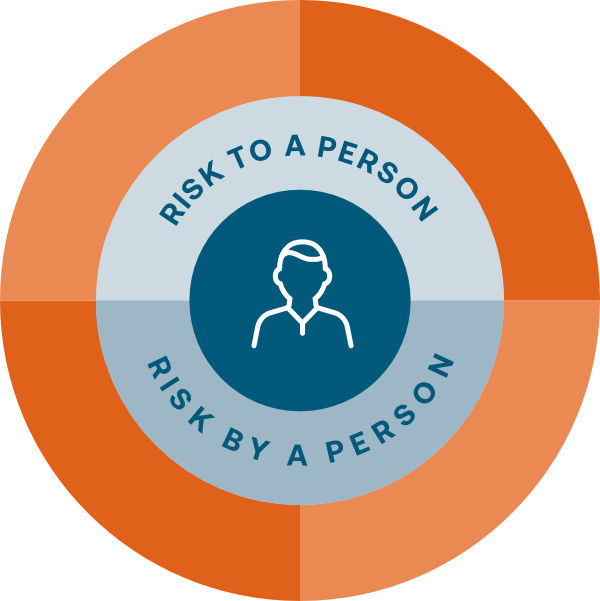
As Captain Steeeve moved through the available footage, he wasn’t simply identifying a series of isolated observations. He was explaining how one condition could affect another, which could then influence another part of the system and ultimately contribute to a very different outcome.
At a high level, excess speed affects the aircraft’s ability to settle onto the runway. Continued float consumes available runway. The way the aircraft settles affects whether particular systems can activate. Those systems affect how effectively lift is reduced and weight transfers onto the wheels, which in turn affects braking effectiveness and stopping distance.
One condition becomes the environment within which another condition develops.
One Risk By can become somebody or something else’s Risk To.
And once we begin moving backwards and forwards through an event in that way—at whatever level of depth the situation requires—we can stop seeing a collection of isolated failures and begin seeing relationships.
That is where the dots start connecting.
When the holes begin to align
Towards the end of his analysis, Captain Steeeve introduced James Reason’s well-known Swiss Cheese Model, using it to explain how multiple conditions can align in a way that allows an accident to occur.
I have always appreciated the Swiss Cheese Model because it challenges the seductive simplicity of believing that serious failures happen because of one bad decision, one failed control or one person getting something wrong.
But perhaps we can take the model another step.
Once we have identified the holes, what if we become curious about the holes themselves?
How did they get there? What conditions created them? Had they existed for some time? Had something made them larger? What was each exposed to? What did each subsequently affect? Why did the safeguards that would normally prevent those holes from aligning fail to interrupt the pathway this time?
And perhaps the most valuable question of all:
Where might similar conditions already be developing somewhere else?
That moves us from simply explaining an incident towards genuinely learning from it.
When the need to learn collides with the need to protect
This is where I think the lesson becomes much bigger than aviation.
Think about what happens when something serious goes wrong inside a corporation, hospital, government department, mine, marine environment, cyber system, community or critical piece of infrastructure.
The greater the consequences, the more important it becomes that we understand what actually happened.
Yet the greater the consequences, the more dangerous openness can become.
People may face disciplinary action or lose their jobs. Organisations may face litigation, regulatory action or enormous reputational damage. Governments face political consequences. Executives worry about shareholders, customers and communities. Insurers become involved. Lawyers quite rightly begin considering legal exposure. Communications teams think carefully about every word that enters the public domain.
And individuals do something deeply human: they protect themselves.
Information becomes guarded. Language becomes careful. People explain or rationalise their decisions. Organisations minimise what they cannot yet confidently explain. Sometimes uncomfortable information doesn’t make it onto the table at all.
I understand why.
Because information can be weaponised and exploited.
When uncertainty becomes ammunition
An organisation might genuinely say, “We have identified something that concerns us, we don’t yet know whether it contributed to the incident, and we are investigating it.”
Yet somewhere between that statement and the next headline, uncertainty can disappear and “we are investigating whether this contributed” can become “organisation admits major failure.”
A provisional observation can become a conclusion. A question can become an accusation. An individual’s willingness to openly discuss a mistake can become evidence used against them.
The very openness that could help us learn can become the thing people learn to fear.
And once people see information being weaponised, we shouldn’t be surprised when they become more careful about what they are prepared to put on the table next time.
That doesn’t mean organisations should hide information or individuals should escape accountability. Nor does it mean legitimate scrutiny should somehow disappear.
It means we need to recognise the environment we have created around failure and ask whether some of our responses to it are unintentionally making genuine learning more difficult.
Because there is another risk sitting quietly inside our attempts to protect ourselves.
What if managing one risk creates another?
If transparency creates a Risk To an organisation—legal, regulatory, political, financial, reputational or personal—it is entirely understandable that the organisation will try to manage that exposure.
But what happens when the way we manage that risk creates another?
If we minimise discussion, restrict information, discourage uncomfortable questions or allow fear of consequences to dominate the inquiry, we may reduce one form of exposure while simultaneously reducing our ability to learn.
That creates another Risk By.
Weak signals remain unexplored. Assumptions survive. Systemic conditions remain hidden. People become less willing to speak. Similar weaknesses can continue developing elsewhere because everybody is focused on containing yesterday’s incident rather than understanding the conditions that made it possible.
The response intended to manage one risk may inadvertently create or amplify another.
And that is why I don’t believe the answer is simply “more transparency”.
There will always be information that cannot or should not immediately be made public. Privacy matters. Procedural fairness matters. Investigative integrity matters. Legal rights matter. Security matters. People should not have their reputations destroyed by speculation masquerading as fact.
The question is more difficult than Should we tell everyone everything?
Perhaps the better question is:
How do we create enough safety to maximise learning without weaponising uncertainty?
A Safe Zone doesn't mean avoiding the uncomfortable
This is where Safe Zones become so important.
When I talk about creating a Safe Zone, I am not talking about creating an environment where difficult questions aren’t asked, uncomfortable information is softened or accountability disappears.
Quite the opposite.
A genuine Safe Zone should give us enough psychological and organisational safety to put more onto the table, not less.
The things we would rather not discuss. The assumptions nobody challenged. The decision that made perfect sense at the time but looks very different with hindsight. The control everyone knew wasn’t really working. The warning somebody noticed but didn’t feel confident enough to raise. The competing pressure that influenced a decision. The possibility that our first explanation is wrong.
A Safe Zone allows those things to be examined without immediately turning the table into a courtroom.
That distinction matters because accountability and inquiry are not enemies, but sequencing them poorly can make them behave as though they are.
If the first question after something goes wrong is Who is responsible?, people may begin protecting themselves before we have given them the opportunity to help us understand what happened.
If instead we first establish an environment where we can explore the situation more openly, we can begin with a wider lens. What was happening around the incident? What conditions existed at the time? What was changing? What information was available—or perhaps missing? What pressures, assumptions, systems, processes, technologies or environmental factors were at play? From there, we can gradually bring the lens closer, exploring the people, teams, decisions and systems involved—not initially by asking what they did wrong, but by understanding the risks to them. What were they navigating, responding to or relying upon, and how might those conditions have influenced what happened next? Only then can we begin to follow the risk in the other direction and explore the risks by them—how decisions, actions, inactions, systems or changing conditions may have created, transferred or amplified risk elsewhere.
Approached this way, we have a much better chance of understanding not simply the final action or failure we can see, but the wider conditions and relationships that allowed the outcome to develop.
Accountability can still come. Consequences can still come.
But perhaps we first need enough clarity to understand what we are actually holding people accountable for, particularly when the environment and conditions surrounding them may hold important clues to what they were exposed to, how that shaped what happened next, and ultimately how risk or harm flowed elsewhere.
Courageous leadership creates space for curiosity
Creating that kind of environment requires courageous leadership.
Not performative courage that promises “full transparency” while quietly controlling the narrative, and not courage measured by how quickly somebody can be identified and held responsible.
It requires leaders who are prepared to hear things they may not like, discover weaknesses in systems they approved, reconsider assumptions they previously defended and allow people to raise information that may be inconvenient, embarrassing or confronting.
It also requires leaders who can tolerate the words:
“We don’t know yet.”
Not indefinitely. Not as an excuse for inaction. But as an honest acknowledgement of where our understanding currently sits.
Because uncertainty does not make leadership weaker. Pretending uncertainty doesn’t exist does.
Courageous leadership creates the conditions in which evidence can be examined, expertise can help people understand what they are seeing, different perspectives can challenge the emerging picture and new information can change our minds without that change being interpreted as failure.
That is how clarity develops.
The purpose isn't simply to explain yesterday
Perhaps one of the greatest opportunities when something goes wrong is not simply determining who was responsible, although accountability will sometimes be essential.
It is creating enough safety, curiosity and courage to understand how the outcome became possible in the first place.
If we use the Swiss Cheese Model, it isn’t enough to identify the holes after they have aligned and congratulate ourselves for completing the postmortem.
We should be asking how those holes got there, what created or enlarged them, what each was exposed to and what each subsequently affected. We should be examining why they aligned when they did, which signals appeared along the way, why those signals weren’t enough to interrupt the pathway, and whether similar conditions may already be quietly developing somewhere else.
Those questions are not designed to remove accountability.
They are designed to give accountability something far more valuable to work with:
clarity.
Captain Steeeve closed his analysis by explaining that the purpose of making these videos isn’t to be salacious, but to hopefully help prevent something similar from happening again.
Perhaps that is the responsibility we all carry when examining failure.
Not to minimise the loss, sanitise uncomfortable information, hunt for someone to blame before we understand what happened, or pretend that accountability doesn’t matter.
But to create the conditions in which we can see more clearly, ask better questions and learn more deeply.
Because finding someone to blame may help us explain yesterday.
Understanding how the conditions for failure developed gives us a much better chance of changing tomorrow.
And that is where the real learning begins.